Europe has one of the world's most established and diversified trade
fair industries. Germany, Italy, France, Spain, the United Kingdom,
the Netherlands, Switzerland and Poland are among the countries with
a particularly strong exhibition sector. Major trade fair cities
include Düsseldorf, Frankfurt, Hanover, Munich, Milan, Paris,
Madrid, Barcelona, London and Amsterdam.
International trade fairs in Europe cover a very
broad range of industries, including
industrial machinery, automotive,
technology, energy,
construction, food and beverages,
tourism, fashion,
furniture and design, logistics,
healthcare, pharmaceuticals and
aerospace. Many European exhibitions are highly
specialized B2B events and attract both exhibitors and professional
visitors from across the world.

Asia has become a major global hub for exhibitions as a result of
its large consumer markets, manufacturing capacity and growing role
in international trade. China has an especially extensive trade fair
calendar, while Japan, South Korea, India, Singapore, Thailand and
Indonesia also host major international events. Shanghai, Guangzhou,
Shenzhen, Beijing, Hong Kong, Tokyo, Osaka, Seoul, Singapore and
Bangkok are among the region's leading exhibition cities.
International trade fairs in Asia are particularly
important for electronics,
digital technology,
telecommunications, manufacturing,
automotive, industrial components,
machinery, energy,
textiles, consumer products and
food. Many Asian fairs also function as major
sourcing platforms connecting manufacturers with importers,
distributors and retailers from international markets.

North America has a large exhibition and convention industry
supported by some of the world's biggest corporate and consumer
markets. The United States hosts a substantial share of the
continent's international events, particularly in Las Vegas,
Chicago, New York, Orlando, Los Angeles, San Francisco and Atlanta.
Toronto, Vancouver and Montreal are important Canadian exhibition
centres, while Mexico provides a growing connection between the
United States, Canada and Latin American markets.
International trade fairs in North America have a
strong presence in technology,
consumer electronics, software,
automotive, aerospace,
construction, healthcare,
food, entertainment,
tourism, energy,
agriculture and business services.
Large North American events frequently combine exhibition areas with
conferences, product launches, professional training and networking
programmes.

South America has a significant regional exhibition market that
increasingly attracts companies from outside the continent. Brazil
is the largest trade fair market in the region, with São Paulo
serving as its main exhibition hub. Argentina, Colombia, Chile and
Peru also organize major business events, particularly in Buenos
Aires, Bogotá, Santiago and Lima.
International trade fairs in South America are
closely linked to the continent's productive sectors, including
agriculture, livestock,
food, mining,
energy, oil and gas,
industrial machinery,
construction, automotive,
tourism, textiles and
technology. These exhibitions provide international
companies with direct access to some of Latin America's largest
commercial markets.

Africa's exhibition industry is developing alongside urban growth,
infrastructure investment, industrialization and the expansion of
regional trade. South Africa, Egypt, Morocco, Kenya and Nigeria are
among the most active markets. Johannesburg, Cape Town, Cairo,
Casablanca, Marrakech, Nairobi and Lagos regularly host exhibitions
aimed at national, regional and international audiences.
International trade fairs in Africa are especially
relevant to agriculture,
food production,
construction and infrastructure,
energy, mining,
oil and gas, telecommunications,
transport, tourism,
healthcare and machinery. Many
events serve as commercial gateways to wider areas of North, West,
East or Southern Africa rather than to a single national market.

Oceania's main trade fair activity is concentrated in Australia and
New Zealand. Sydney, Melbourne, Brisbane, Perth and Auckland host
many of the region's leading exhibitions and professional events.
Although the overall market is smaller than those of Europe, Asia or
North America, it is strongly connected to international trade
throughout the Asia-Pacific region.
International trade fairs in Oceania are prominent
in mining, agriculture,
food, construction,
energy, technology,
healthcare, education,
tourism, marine industries and
professional services. Australia is particularly
important for exhibitions linked to natural resources and mining
technology, while both Australia and New Zealand maintain strong
commercial ties with Asian markets.

International Trade Fairs in Antarctica
Antarctica is fundamentally different from every other continent in
terms of trade fairs. It has no permanent cities, conventional
commercial economy or exhibition infrastructure, and therefore does
not host an international trade fair market comparable to those
found elsewhere in the world.
International activity connected with Antarctica mainly concerns
scientific research,
environmental protection,
international cooperation and the operation of
research stations. Conferences and exhibitions dealing with
Antarctic science, logistics or policy are generally organized in
cities on other continents.
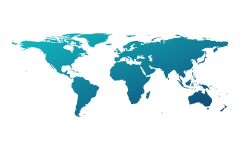
The global map of international trade fairs reflects
the economic strengths of each region. Europe has a particularly
mature industrial and professional exhibition sector; Asia stands out
for manufacturing, sourcing and technology; North America for
innovation and business services; South America for agriculture,
mining and natural resources; Africa for infrastructure, energy and
expanding regional markets; and Oceania for resources, agriculture and
its connections with the Asia-Pacific economy. Together, these events
form an important part of international trade and professional
exchange.